Articles
Share post:
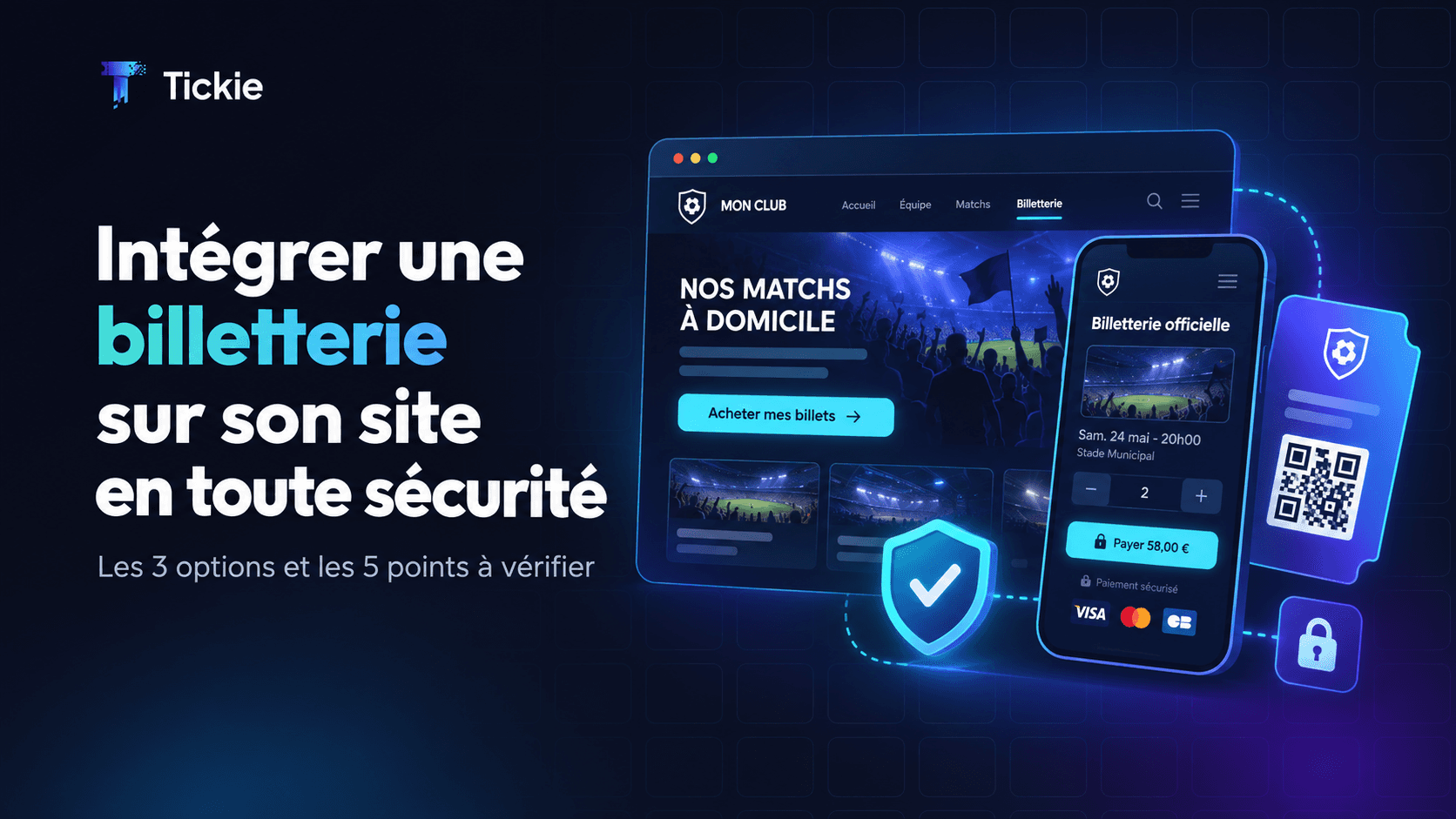
A fan who wants to buy a ticket goes to their club's website first. That's where they feel at home, and that's where they trust what they see.
Send them to an unfamiliar page, with a different address and a different design, and some buyers hesitate, and some give up. Adding ticketing to your website means keeping fans where they feel at home, all the way to checkout.
But you still need to do it securely. In this guide, we compare the three ways to add ticketing to your website, then walk through the five security points to check.
Key takeaways
There are three ways to add ticketing to your website: a link to an external page, a widget embedded in a page, or a white-label ticketing platform on your own domain. The third offers the most trust, control over your data and tracking capabilities. Whichever you choose, check payments, data protection, and protection against bots and fake sites.
3 ways to add ticketing to your website
1. A link to an external page
A “Tickets” button on the club's website sends fans to a page hosted by the provider.
Pros: quick to set up, with no technical skills required.
Cons: fans leave the club's website for an address they don't recognize. The provider's brand is often visible, and ad tracking is limited.
Best for: a one-off event, or an organization that doesn't have a website yet.
How to do it: grab the address of your ticketing page, then add a “Tickets” button to your website's menu that links to it.
2. A widget embedded in a page
A sales module appears directly on a page of the club's website, using a code snippet you copy and paste.
Pros: fans stay on the club's website, and the module matches its colors.
Cons: how it looks depends on the host website. On some sites, especially on mobile, the module can feel less smooth than a dedicated page.
Best for: an organizer who wants to sell from one specific page of their website, without a bigger project.
How to do it: copy the embed code provided by your ticketing platform, then paste it into the page of your website where you want the sales module to appear. Most website builders (WordPress, Wix, Framer...) have a block designed for adding this kind of code. Then test how it looks on mobile.
3. A white-label ticketing platform on your own domain
The ticketing platform has its own address in the club's name, for example tickets.yourclub.com. It carries the club's full brand identity, and the provider's name doesn't appear anywhere.
Pros: an official ticketing platform that's recognizable and reassuring. The club's website gets an SEO boost, confirmation emails can be sent in the club's name, and ad tracking tools work to their full potential.
Cons: a slightly longer initial setup, with a technical setting on the domain name.
Best for: clubs and organizers who sell year-round and want a ticketing platform that lives up to their brand.
How to do it: choose your ticketing address, for example tickets.yourclub.com. Then, with your domain name host, add the technical setting your provider gives you (a record called a CNAME). Your provider can help you with this step.
To understand the differences between the main types of ticketing platforms, check out our guide to choosing online ticketing software.
5 security points to check
1. Payments
The risk: a poorly protected payment page, or payment options so limited that buyers abandon their purchase.
The protection: a reputable payment provider, compliant with PCI-DSS (the security standard for card payments), with 3D Secure, which asks fans to confirm their payment with their bank, and the payment methods people use every day: Apple Pay, Google Pay, and pay-in-installments options.
2. Attendee data
The risk: personal data that's exposed, or used by parties other than the club.
The protection: encrypted data, a GDPR-compliant platform, and buyers who remain the club's own contacts. This data is valuable: our article on event CRM explains how to use it to sell more.
3. Fake sites and scams
The risk: sites that imitate the official ticketing platform to sell fake tickets, or tickets at inflated prices.
The protection: an official address on the club's domain that's easy to recognize. Share it everywhere (website, social media, emails) so fans know where to buy.
4. Bots
The risk: automated programs that buy tickets in bulk as soon as sales open, to resell them at a higher price.
The protection: a platform that detects and blocks automated purchases, so seats go to real fans.
5. Traffic spikes
The risk: a ticketing platform that slows down or crashes on the day of a big on-sale, right when everything is on the line.
The protection: infrastructure built to handle thousands of simultaneous connections. It's a key issue for clubs, especially during the season ticket renewal campaign, as we explain in our article on the ticketing season calendar.
How Tickie adds ticketing to your website
You choose how to add your ticketing platform: a link, a widget, or a full white label on your own domain. With white label, our name doesn't appear anywhere: the ticketing platform carries only your brand, and confirmation emails are sent in your name. That's what US Carcassonne chose: its official ticketing platform is available at billetterie.uscarcassonne.com, in the club's colors.
Every purchase is also secure, and designed to help you sell more:
Payments go through Adyen, one of the world's leading online payment providers, with 3D Secure, Apple Pay, Google Pay, and pay-in-installments with Klarna.
Data is encrypted, and the platform complies with PCI-DSS standards and the GDPR.
Bots are detected and blocked, so tickets go to real fans.
Traffic spikes are absorbed by infrastructure built for big on-sales.
Your Meta and Google pixels can be installed on the ticketing platform, so you can measure the return on your ads.
Frequently asked questions
Widget or subdomain: which should you choose?
A widget is enough to sell from one specific page of your website. A white-label subdomain is better suited to clubs and organizers who sell year-round: it offers a complete, recognizable ticketing platform and better sales tracking.
Is ticketing embedded in your website secure?
Yes, as long as you check the payment provider, data protection and bot protection. Payments are always processed by a specialized provider, which doesn't share banking details with the club.
How can fans recognize the official ticketing platform?
By its address: an official ticketing platform is accessible from the club's website, or at an address in the club's name. When in doubt, the safest option is to always go through the club's official website.
Can you track your ads on your ticketing platform?
Yes, if the ticketing platform lets you install your tracking pixels, such as Meta's or Google's. The club can then measure which campaigns drive ticket sales.
Your ticketing deserves your club's address
For a fan, the ticketing platform is the club. When they click “Buy my ticket,” they should feel at home: same address, same colors, same trust. Every detour through an unfamiliar page is a chance to doubt, give up, or land on a fake site.
For the club, the stakes are just as concrete. Well-integrated ticketing means fans who buy in a few seconds, data that stays with the club, and campaigns whose results you can finally measure. During a big on-sale, it also means a platform that holds up when thousands of fans log on at the same time.
One simple question tells you where you stand: today, when a fan buys a ticket, do they know right away that they're on your club's official ticketing platform?
Your ticketing should extend your club's experience, not break it. To build a smoother, more reassuring checkout flow that's fully integrated with your brand, talk to the Tickie team.
Share post:


